
Eata Energy supplies alloy evaporation materials for laboratories, pilot-scale development, and industrial thin-film programs. The portfolio covers binary, ternary, and multicomponent alloy systems intended for thermal evaporation, electron-beam evaporation, and other vacuum-deposition workflows.
Product selection can be aligned with the required alloy chemistry, purity, physical form, source geometry, and target film function. Because multicomponent materials do not always evaporate congruently, the final process should be qualified against the individual alloy, deposition equipment, and film-composition target.
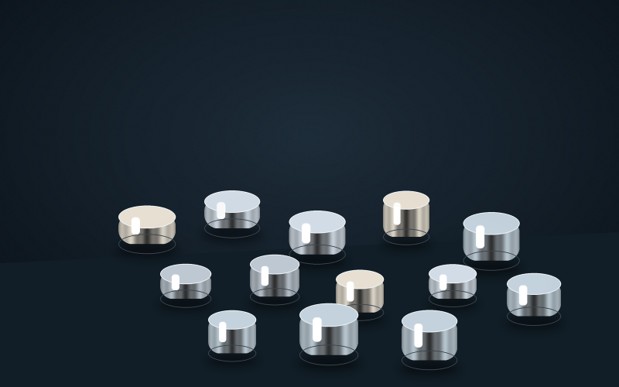 Figure 1. Precision-formed alloy source pellets for controlled loading in evaporation systems.
Alloy evaporation materials are pre-combined metallic sources used to deposit multielement thin films under vacuum. Energy supplied by a resistive heater or a focused electron beam raises the source to a useful vapor pressure; the vapor then travels through the low-pressure chamber and condenses on a substrate as a film.
The main advantage of starting from an alloy source is the ability to introduce a defined combination of elements from one material. The practical challenge is that each element has its own vapor pressure, activity, melting behavior, and interaction with the crucible or boat. For this reason, source composition, source form, heating method, and deposition parameters should be considered together rather than treated as independent choices.
| Selection Factor | Why It Matters | Typical Options |
| Alloy composition | Defines the intended elemental ratio and functional behavior of the deposited layer. | Binary, ternary, quaternary, high-entropy, or project-specific chemistry. |
| Purity and impurity profile | Trace elements can alter electrical, optical, magnetic, interfacial, and mechanical performance. | Nominal purity grade, controlled metallic impurities, oxygen, nitrogen, and carbon where relevant. |
| Physical form | Packing density, melting behavior, charge stability, and source compatibility depend on geometry. | Pellets, granules, pieces, blocks, rods, wire, powder, or compacted forms, subject to material feasibility. |
| Vapor-pressure relationship | Large differences between alloy components can cause preferential evaporation and film-composition drift. | Review component vapor pressures, source depletion behavior, and measured film stoichiometry. |
| Deposition hardware | The heater, boat, crucible liner, hearth, and available power influence process stability. | Thermal or electron-beam source, compatible container material, charge depth, and source conditioning. |
| Particle or piece size | Consistent dimensions support repeatable loading, packing, and melt-pool behavior. | Standard granule ranges or custom dimensions matched to the source pocket or crucible. |
| Material Family | Representative Alloy Systems | Common Development Focus |
| Aluminum-based alloys | Al-Si, Al-Mg, Al-Cu-Si | Conductive or reflective layers, interconnect studies, lightweight alloy films, and interface engineering. |
| Nickel-based and magnetic alloys | Ni-Fe, Ni-Si, Ni-Y | Soft-magnetic films, contact layers, silicide research, and functional alloy development. |
| Titanium and refractory-alloy systems | Ti-Mo, Ti-Sc, Fe-Ta, Fe-Zr | High-temperature coatings, corrosion-resistant layers, structural or barrier-film research. |
| Rare-earth-containing alloys | Ce-Mg, Mg-La, Ce-Fe, Ni-Y | Rare-earth alloy films, magnetic or catalytic material studies, and composition-dependent functional coatings. |
| Energy and thermoelectric alloys | Si-Ge, Mg-Ni (Mg2Ni), Fe-Ti | Thermoelectric layers, hydrogen-related materials, energy-conversion research, and functional electrodes. |
| Multicomponent and advanced alloys | Ag-Sn-Cu-Ni, Al-Co-Cr-Fe-Ni | Electronic alloy layers, composition-screening programs, and high-entropy or multiphase coating research. |
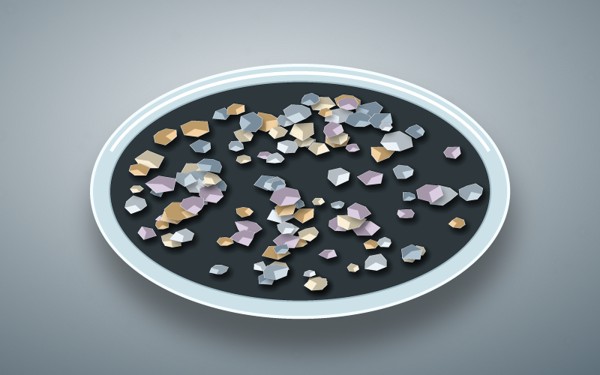 Figure 2. Mixed alloy granules illustrating the range of compositions and source morphologies used in material development.
Bulk alloy chemistry does not automatically guarantee identical film chemistry. In a multicomponent melt, the vapor composition is influenced by both the concentration and vapor pressure of each element. Components with higher effective volatility can be enriched in the vapor, while less volatile components may accumulate in the remaining source charge.
Alloys whose components have relatively compatible evaporation behavior can sometimes transfer composition more faithfully. When the vapor-pressure difference is large, process development may require tighter rate control, source conditioning, a modified starting composition, sequential or co-evaporation, or a different deposition method. Film composition should therefore be verified by an appropriate analytical method rather than inferred from source chemistry alone.
| Route | Where It Can Fit | Points to Review |
| Thermal evaporation | Suitable for alloy systems that can be heated efficiently in a compatible boat, filament, or crucible and that do not excessively attack the source container. | Required temperature, wetting, reaction with refractory heaters, vapor-pressure mismatch, spitting, and rate stability. |
| Electron-beam evaporation | Useful for many higher-melting or power-intensive alloys because the beam concentrates energy directly on the source charge. | Hearth or liner compatibility, melt-pool stability, pre-melting, beam sweep, charge packing, power demand, and composition shift. |
| Co-evaporation or sequential deposition | An alternative when one pre-alloyed source cannot provide the required film stoichiometry or compositional gradient. | Independent rate calibration, source cross-talk, substrate rotation, layer mixing, and post-deposition treatment. |
 Figure 3. Conceptual vacuum-evaporation chamber with localized source heating and upward material transport.
Alloy thin films are explored where a single element cannot provide the required combination of conductivity, magnetism, optical response, adhesion, corrosion resistance, diffusion control, or thermal stability. The appropriate alloy depends on the full device stack and the deposition conditions.
| Application Area | Potential Film Function | Relevant Material Directions |
| Semiconductors and microelectronics | Metallization, contact formation, interconnects, diffusion barriers, silicide layers, and interface modification. | Al-Cu-Si, Al-Si, Ni-Si, Ni-Fe, and other composition-controlled electronic alloys. |
| Optical and photonic coatings | Reflective, absorptive, wavelength-selective, durable, or decorative metallic layers. | Al-based, Ni-based, Ag-containing, rare-earth-containing, and custom optical alloy systems. |
| Magnetic and sensing devices | Soft-magnetic layers, magnetic shielding, transducer structures, and field-responsive surfaces. | Ni-Fe, Ce-Fe, Ni-Y, and other magnetic alloy compositions. |
| Energy conversion and storage research | Thermoelectric layers, hydrogen-related materials, electrodes, and photovoltaic device contacts. | Si-Ge, Mg-Ni, Fe-Ti, Al-based contact alloys, and project-specific functional compositions. |
| Protective and high-temperature coatings | Oxidation, wear, corrosion, diffusion, or thermal protection in demanding environments. | Ti-Mo, Fe-Ta, Fe-Zr, multicomponent high-entropy alloys, and refractory-alloy systems. |
| Materials discovery and prototyping | Composition screening, gradient libraries, phase studies, and proof-of-concept device stacks. | Binary through multicomponent alloys with adjustable ratios and custom source forms. |
 Figure 4. Multilayer device concept showing an alloy-rich surface layer integrated into a thin-film stack.
Eata Energy can review custom requests for alloy evaporation materials when a standard listing does not match the project. Customization may involve elemental ratio, purity, impurity limits, granule or pellet dimensions, block or rod geometry, particle-size range, quantity, and packaging format. Feasibility depends on the alloy system, manufacturing route, stability, and intended deposition method.
For composition-sensitive projects, share the desired source chemistry together with the target film composition and deposition setup. This helps distinguish a request for a nominal bulk alloy from a request that may require compensation for preferential evaporation or a different source strategy.
 Figure 5. Concept view of alloy microstructure and multielement lattice design for customized material development.
| Catalog Number | Product Name | Order | Quantity |
|---|---|---|---|
| SEMAEM-0001 | 99.99% Spherical Titanium–Scandium Alloy Granules with 12 wt% Sc | Inquiry | |
| SEMAEM-0002 | 99.9% Magnesium–Lanthanum Alloy Granules, 10–500 μm | Inquiry | |
| SEMAEM-0003 | 99.9% Nickel–Yttrium Rare-Earth Alloy Blocks (NiY) | Inquiry | |
| SEMAEM-0004 | Cerium–Magnesium Rare-Earth Alloy Evaporation Granules (CeMg) | Inquiry | |
| SEMAEM-0005 | 99.9% Aluminum–Magnesium Lightweight Alloy Granules (Al-Mg) | Inquiry | |
| SEMAEM-0006 | 99.9% Iron–Carbon Composite Alloy Granules, 5–20 wt% C | Inquiry | |
| SEMAEM-0007 | Nickel–Silicon Alloy Evaporation Granules (NiSi) | Inquiry | |
| SEMAEM-0008 | 99.99% Aluminum–Silicon Eutectic Alloy Granules, 10–50 at% Si | Inquiry | |
| SEMAEM-0009 | 99.999% N-Type Silicon–Germanium Thermoelectric Granules (SiGe) | Inquiry | |
| SEMAEM-0010 | 99.9% Nickel–Iron Soft-Magnetic Alloy Granules (NiFe) | Inquiry |
For Research or Industrial Raw Materials, Not For Personal Medical Use!
|
There is no product in your cart. |

Eata Energy is your trusted partner for high-performance energy materials, customized R&D support, and a stable global supply chain. We support you every step of the way in energy innovation.
Enter your E-mail and receive the latest news from us.
Copyright © Eata Energy. All rights reserved.
