
Gallium occupies a singular position in the periodic table — the only element that transitions from solid to liquid within a few degrees of comfortable room temperature. With a melting point of merely 29.76°C, a piece of high-purity gallium will literally liquefy in the warmth of a human hand, yet its boiling point of 2403°C gives it the widest liquid temperature range of any known substance. This extraordinary thermal behavior, combined with gallium's position in Group 13 and its capacity to form compound semiconductors with exceptional electronic properties, makes it an irreplaceable raw material for GaAs and GaN device fabrication, advanced thermal management systems, and frontier research in flexible electronics.
Eata Energy supplies high-purity gallium metal across an extensive purity spectrum from 4N (99.99%) to 8N (99.999999%), available as ingots, pellets, sealed ampoules, and custom-configured forms. Each batch undergoes rigorous characterization via GDMS and ICP-MS, with full analytical documentation provided to support your most demanding epitaxial growth, precursor synthesis, or materials research programs.
Gallium's unusual crystal structure and bonding characteristics give rise to a set of properties that have fascinated chemists since its discovery by Lecoq de Boisbaudran in 1875. Mendeleev had predicted its existence as "eka-aluminum" years earlier based on gaps in his periodic table.
| Property | Value | Notes |
| Atomic Number | 31 | Group 13, Period 4 |
| Atomic Weight | 69.72 g/mol | |
| Density (solid) | 5.904 g/cm³ | Liquid: 6.095 g/cm³ |
| Melting Point | 29.76°C | Melts in hand |
| Boiling Point | 2403°C | Widest liquid range |
| Crystal Structure | Orthorhombic | Complex, 8-atom cell |
| Thermal Conductivity | 29 W/m·K | Higher than many liquids |
| Electrical Resistivity | 25.8 μΩ·cm | @ 30°C |
| CAS Number | 7440-55-3 | EINECS: 231-163-8 |
| Expansion on Freezing | +3.1% | Stores in plastic only |
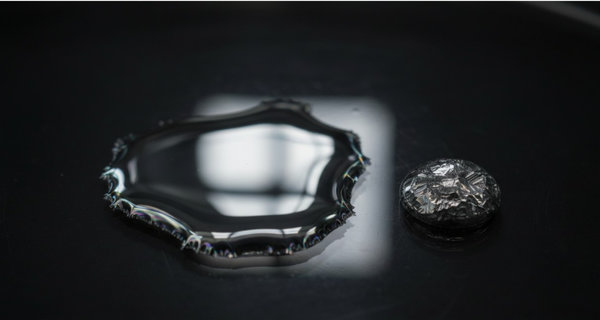 Figure 1: A pool of liquid gallium metal with its characteristic mirror-like reflective surface beside a solidified droplet
One of gallium's most peculiar properties is its expansion upon freezing — by approximately 3.1% — a behavior shared by only a handful of elements including water and bismuth. This expansion necessitates storage in flexible plastic containers rather than rigid glass to prevent cracking. Gallium's natural oxide skin, which forms instantaneously on exposure to air, enables the liquid metal to hold shapes and be manipulated in ways that mercury cannot — a property extensively exploited in soft robotics and stretchable circuit research.
Eata Energy stocks gallium in configurations suited to semiconductor manufacturing, research laboratories, and industrial process development, with each form packaged to prevent oxidation and contamination.
Solid ingots and pellets provide the standard feedstock for most research and manufacturing applications. Material is cast under inert atmosphere and sealed to preserve surface cleanliness.
Ultra-high-purity gallium for MBE effusion cells and critical epitaxial growth applications is supplied in quartz or borosilicate ampoules sealed under high vacuum or inert gas. This packaging eliminates atmospheric exposure and particulate contamination during transfer to deposition systems.
 Figure 2: Row of high-purity gallium metal ingots displaying silvery-blue metallic luster
For applications requiring immediate liquid-phase access, we supply pre-melted gallium and eutectic gallium-indium alloy (EGaIn, 75.5% Ga / 24.5% In, melting point 15.5°C) in syringes or sealed vials. These formats support microfluidics, soft electronics, thermal interface material research, and flexible sensor development.
Approximately 98% of gallium metal consumption worldwide supports the production of gallium arsenide and gallium nitride compound semiconductors. GaAs dominates high-frequency integrated circuits, RF power amplifiers in smartphones, and high-efficiency solar cells for space applications. GaN powers the blue and white LED revolution, 5G base station amplifiers, and next-generation power electronics for electric vehicles. The synthesis of trimethylgallium (TMGa) and triethylgallium (TEGa) — the standard MOCVD precursors for III-V and III-N epitaxy — demands 6N+ purity gallium as starting material. Impurities at the ppb level directly affect carrier concentration, minority carrier lifetime, and optical efficiency in the resulting devices.
 Figure 3: Gallium arsenide semiconductor wafer with reflective surface showing crystallographic orientation marks
MBE growth of III-V heterostructures — including quantum wells, quantum dots, and two-dimensional electron gas systems — requires 7N to 8N purity gallium loaded into effusion cells. At these purity levels, total impurity content is below 1 μg/kg, with individual contaminants such as Si, Fe, Cu, Mg, and Ca held below 0.1 ppb. Such extreme purity is essential for achieving the precise doping control and interface abruptness that quantum device performance demands.
Gallium and its alloys (EGaIn, Galinstan) offer thermal conductivities exceeding 30 W/m·K in the liquid state — an order of magnitude higher than conventional silicone thermal pastes. Their ability to conform to microscopic surface roughness eliminates thermal contact resistance at chip-to-heat-sink interfaces. Research programs are actively exploring liquid metal cooling for high-power LEDs, concentrator photovoltaics, and extreme-performance computing systems where conventional thermal greases reach their limits.
 Figure 4: Liquid gallium-based thermal interface material spreading between a processor and heat sink base
The natural oxide skin that forms on liquid gallium enables patterning into wires, droplets, and complex geometries for stretchable conductors, reconfigurable antennas, and self-healing circuits. When the oxide is mechanically disrupted, the liquid metal flows and reforms — a property that supports self-repairing electronic systems. EGaIn and related alloys have become standard materials in the rapidly growing field of soft robotics and wearable electronics research.
Copper-indium-gallium-selenide (CIGS) thin-film solar cells leverage gallium's bandgap-tuning capability to achieve laboratory efficiencies exceeding 23%. Multi-junction GaAs-based solar cells on germanium substrates, grown by MOCVD or MBE, deliver efficiencies above 47% under concentrated sunlight and power satellites including the Mars Exploration Rovers. High-purity gallium feedstock with controlled indium and aluminum co-doping profiles is critical for optimizing these photovoltaic systems.
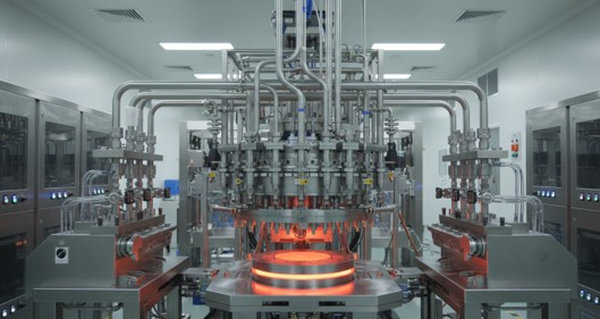 Figure 5: MOCVD reactor system with heated susceptor for epitaxial growth of III-V semiconductor layers
Selecting the appropriate gallium purity grade is critical — semiconductor device performance is directly influenced by trace impurity levels in the starting metal. The following matrix correlates purity grades with typical end uses.
| Grade | Characteristics | Recommended For |
| Ga 4N (99.99%) | General lab; Si, Fe < 10 ppm | Liquid metal alloys, low-melt alloys, calibrations |
| Ga 5N (99.999%) | UV bulbs, heat transfer media; Si, Fe < 1 ppm | Vacuum pumps, thermal transfer fluids, general electronics |
| Ga 6N (99.9999%) | Optoelectronic; individual metals < 0.1 ppm | LEDs, laser diodes, GaN MOCVD, magnetic materials |
| Ga 7N (99.99999%) | IC-grade; total impurities < 100 μg/kg | GaAs IC substrates, semi-insulating GaAs, HEMT devices |
| Ga 8N (99.999999%) | MBE ultra-pure; ppb-level control | Quantum devices, MBE source, GaN blue LEDs, microwave circuits |
Eata Energy verifies every gallium batch through a comprehensive analytical protocol designed to confirm purity at the ppb level and ensure suitability for the intended application.
Frontier research in compound semiconductors, quantum devices, and soft electronics frequently demands gallium configurations that extend beyond standard catalog offerings. Eata Energy partners with your technical team to deliver bespoke solutions.
Engage our materials scientists during project planning to optimize gallium purity, form, and packaging for your specific epitaxial growth system, device architecture, or research protocol.
| Catalog Number | Product Name | Order | Quantity |
|---|---|---|---|
| HPMHPG-0001 | Liquid Gallium, 99.999995% (7N5) | Inquiry | |
| HPM-HPG-0001 | High-Purity Gallium Lump, 25 mm | Inquiry | |
| HPMHPG-0002 | Gallium Rod, 99.999995% (7N5) | Inquiry | |
| HPM-HPG-0002 | Ultra-High-Purity Gallium Rods and Pellets | Inquiry | |
| HPMHPG-0003 | Gallium Granules, 99.999995% (7N5) | Inquiry | |
| HPM-HPG-0003 | High-Purity Gallium Ingot and Granules | Inquiry | |
| HPMHPG-0004 | Ultra-High-Purity Gallium Metal, 5N–7N, Powder or Ingot | Inquiry |
For Research or Industrial Raw Materials, Not For Personal Medical Use!
|
There is no product in your cart. |

Eata Energy is your trusted partner for high-performance energy materials, customized R&D support, and a stable global supply chain. We support you every step of the way in energy innovation.
Enter your E-mail and receive the latest news from us.
Copyright © Eata Energy. All rights reserved.
