
Ask a marine engineer which material they trust below the waterline, and the answer rarely changes: copper-nickel. For more than half a century, cupronickel alloys have carried seawater through condensers, cooled coastal power plants, and lined the piping of ships and offshore platforms — quietly outlasting stainless steels in the very environments that destroy them.
Eata Energy supplies copper-nickel raw materials for research and industry alike: the proven 90/10 and 70/30 seawater grades, high-iron variants built for turbulent flow, constantan resistance alloys for precision electrical work, and the tubes, plates, bars, wires and custom forms that turn these alloys into working hardware.
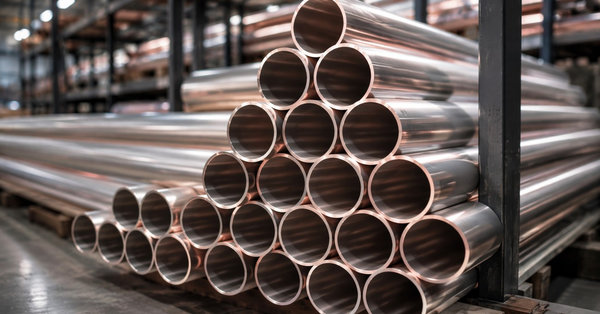 Copper-nickel tubes stocked for condenser, heat-exchanger and seawater-piping service.
Copper-nickel alloys — cupronickels, as the industry calls them — are single-phase, face-centered-cubic solid solutions in which nickel dissolves completely into the copper lattice. The two classic marine grades carry roughly 10% and 30% nickel, yet the real engineering detail hides in the minor additions: one to two percent of iron strengthens the protective film that grows on the metal in seawater, while manganese improves hot workability and ties up residual sulfur. The alloy's electrode potential ends up close to neutral against seawater itself — the fundamental reason cupronickel resists attack where ordinary copper and many stainless grades cannot.
Push nickel further, toward 45%, and the family changes personality. Resistivity climbs to about 49 μΩ·cm while the temperature coefficient of resistance falls nearly to zero. That branch of the family — constantan — leaves the ocean behind and moves into laboratories and instrument panels, where it becomes precision resistors, strain-gauge grids and thermocouple legs.
| Grade | Composition Highlights | What Sets It Apart | Typical Destinations |
| Cu-Ni 90/10 (UNS C70600) | ~10% Ni, 1.0–1.8% Fe | The seawater workhorse: excellent formability, thermal conductivity and value | Condenser and heat-exchanger tubes, seawater piping, hull sheathing |
| Cu-Ni 70/30 (UNS C71500) | ~30% Ni, 0.4–1.0% Fe | Roughly 25% stronger than 90/10; superior in fast, warm or polluted seawater | Offshore piping, desalination units, naval hardware |
| Cu-Ni 66/30/2/2 (UNS C71640) | 30% Ni with 2% Fe, 2% Mn | Maximum erosion-corrosion resistance in turbulent, high-velocity flow | Pump casings, water boxes, high-flow headers, condenser tubing |
| Constantan / CuNi44 (UNS C72150) | 43–45% Ni | Resistivity ≈ 49 μΩ·cm with near-zero temperature coefficient; non-magnetic | Precision resistors, strain gauges, shunts, thermocouple wire |
| CuNi2 – CuNi34 series | Nickel stepped 2–34% | Resistivity tunes from about 0.05 to 0.49 μΩ·m as nickel content rises | Heating cables, current shunts, low-voltage resistive elements |
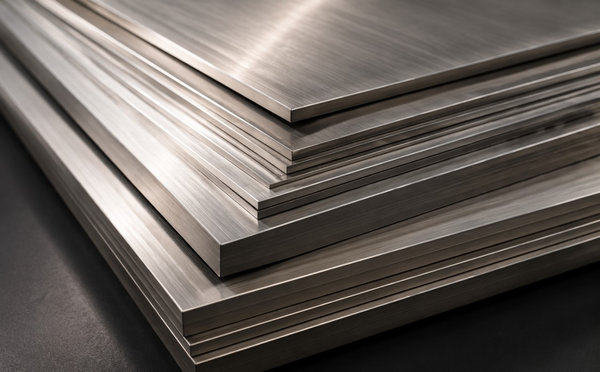 Brushed copper-nickel plates and sheets ready for fabrication into condenser and structural components.
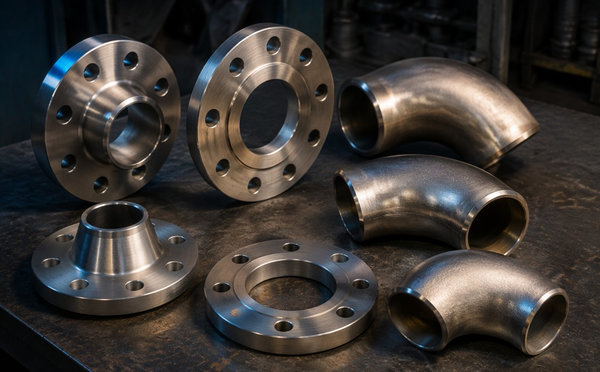 Copper-nickel flanges and elbow fittings machined for seawater piping systems.
Seawater cooling loops, fire-main piping, ballast systems, hull sheathing and splash-zone hardware all face the same enemy: warm, oxygen-rich, organism-filled seawater. Cupronickel's self-repairing film and fouling-resistant surface were effectively invented for this duty, and five decades of service records back the choice.
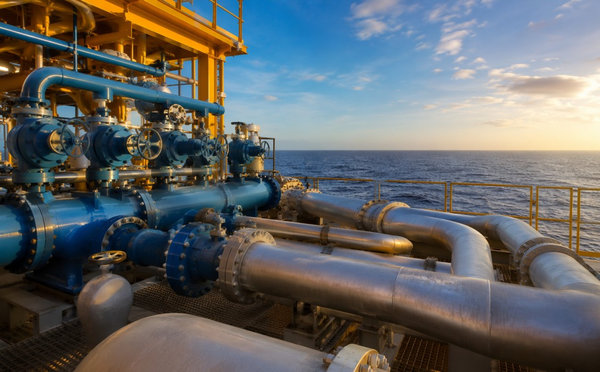 Seawater piping on offshore installations relies on copper-nickel for decades of corrosion-free service.
Multistage-flash evaporators, heat-recovery and heat-rejection sections, condenser tubes and water boxes form the thermal heart of desalination and coastal power plants. Modified 70/30 tubing with elevated iron and manganese is the established choice in the highest-velocity, most corrosive sections of these systems.
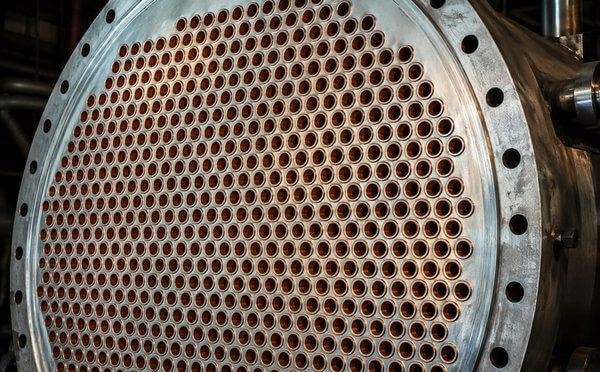 Tube bundles for condensers and heat exchangers are the largest single destination for 90/10 and 70/30 tube.
Valve bodies, pump internals, process piping and flexible hose all benefit from an alloy that tolerates chlorides, dilute acids and alkaline streams — without the stress-corrosion surprises that stainless steels can spring in the same duty.
Constantan wire and strip become wire-wound precision resistors stable up to 400 °C, strain-gauge grids, current shunts, and the negative legs of Type J and Type T thermocouples — applications that depend on resistance staying put while temperature moves.
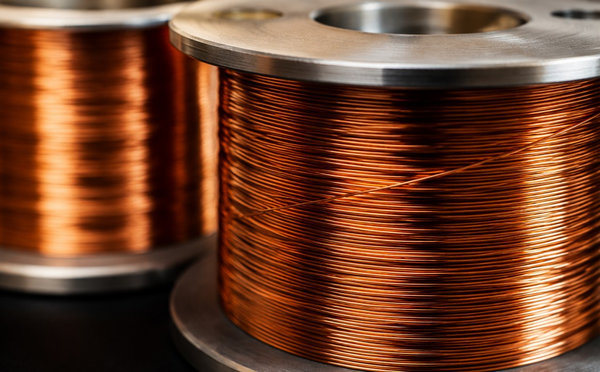 Constantan resistance wire wound on spools for precision electrical and sensing components.
Universities, institutes and R&D groups draw on our plates, foils, wires and powders for corrosion studies, coating development, powder metallurgy and prototype alloy programs — with small-batch supply matched to experimental work.
Standard grades solve standard problems. For everything else, Eata Energy adjusts nickel and iron content within specification windows, sources non-standard diameters and wall thicknesses, draws wire and rolls strip to special gauges, atomizes powder to target size distributions, and machines finished components to your drawing. Send us the service conditions or the specification, and we will come back with a material plan and a quotation tailored to the job.
| Catalog Number | Product Name | Order | Quantity |
|---|---|---|---|
| HPACNA-0001 | Zinc-Copper Couple Alloy | Inquiry | |
| HPACNA-0002 | Devarda Alloy (Powder Form) | Inquiry | |
| HPACNA-0003 | Low-Melting Fusible Alloy (Woods Alloy) | Inquiry | |
| HPACNA-0004 | Copper-Tin Alloy (Bronze) Spherical Powder | Inquiry | |
| HPACNA-0005 | Devarda Alloy (Filings Form) | Inquiry | |
| HPACNA-0006 | Low-Melting Fusible Alloy (Woods Alloy Stick Form) | Inquiry | |
| HPACNA-0007 | Manganin Resistance Alloy Wire | Inquiry | |
| HPACNA-0008 | Bronze Alloy Atomized Powder | Inquiry | |
| HPACNA-0009 | Tinned Copper Wire (200 m) | Inquiry | |
| HPACNA-0010 | Tinned Copper Wire (1000 m) | Inquiry |
For Research or Industrial Raw Materials, Not For Personal Medical Use!
|
There is no product in your cart. |

Eata Energy is your trusted partner for high-performance energy materials, customized R&D support, and a stable global supply chain. We support you every step of the way in energy innovation.
Enter your E-mail and receive the latest news from us.
Copyright © Eata Energy. All rights reserved.
