
Oxide evaporation materials form the backbone of modern thin-film coating technology, enabling the precise deposition of dielectric, optical, and functional layers across a staggering range of industries. From anti-reflective coatings on camera lenses to high-k gate dielectrics in advanced semiconductors, these ceramic compounds are vaporized under vacuum and condensed onto substrates as nanometer-thick films with tailored properties. At Eata Energy, we manufacture a comprehensive portfolio of high-purity oxide evaporation materials engineered for consistent performance in both thermal and electron-beam deposition systems.
Our product lineup spans low-index materials like silicon dioxide, high-index compounds including titanium dioxide and tantalum pentoxide, and specialty oxides such as hafnium oxide and indium tin oxide. Each formulation is available in multiple physical forms—pellets, granules, tablets, and powder—to accommodate different crucible geometries and evaporation source designs. Whether you are building multilayer optical stacks, developing next-generation photovoltaic devices, or scaling up semiconductor manufacturing, our oxide evaporation materials provide the purity, uniformity, and process reliability your applications demand.
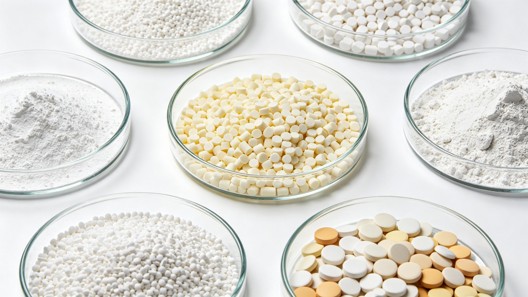 Fig 1: Assortment of high-purity oxide evaporation materials in various forms including pellets, granules, and powder.
The table below highlights our most widely requested oxide evaporation materials. Each entry reflects typical specifications; custom purity levels, particle size distributions, and specialized forms are available upon request.
| Material | Formula | Purity | Melting Point (°C) | Available Forms | Primary Use |
| Aluminum Oxide | Al₂O₃ | 99.99% | 2045 | Granules / Tablets / Powder | AR coatings, gate dielectrics, passivation |
| Silicon Dioxide | SiO₂ | 99.999% | 1610 | Granules / Pieces / Powder | Low-index optical layers, insulation |
| Titanium Dioxide | TiO₂ | 99.99% | 1800 | Tablets / Granules / Powder | High-index optical coatings, UV filters |
| Titanium Pentoxide | Ti₃O₅ | 99.99% | 1700 | Tablets / Granules | Stable high-index optical films |
| Tantalum Pentoxide | Ta₂O₅ | 99.99% | 1800 | Tablets / Granules / Powder | High-index dielectric, waveguides |
| Hafnium Oxide | HfO₂ | 99.99% | 2812 | Pellets / Granules / Powder | High-k gate dielectrics, DRAM capacitors |
| Zirconium Oxide | ZrO₂ | 99.99% | 2700 | Granules / Tablets / Powder | High-index coatings, thermal barrier films |
| Magnesium Oxide | MgO | 99.95% | 2800 | Granules / Pieces / Powder | Protective coatings, buffer layers |
| Indium Tin Oxide | ITO | 99.99% | 1900 | Pellets / Powder | Transparent conductive films, displays |
| Zinc Oxide | ZnO | 99.99% | 1975 | Tablets / Granules / Powder | Transparent conductors, piezoelectric films |
| Chromium Oxide | Cr₂O₃ | 99.99% | 2453 | Granules / Powder | Hard coatings, color filters |
| Niobium Pentoxide | Nb₂O₅ | 99.95% | 1530 | Granules / Tablets / Powder | High-index optical layers |
| Yttrium Oxide | Y₂O₃ | 99.99% | 2680 | Granules / Powder | Protective coatings, laser host materials |
| Cerium Oxide | CeO₂ | 99.99% | 2600 | Granules / Tablets / Powder | Polishing, oxygen ion conductors |
| Tin Oxide | SnO₂ | 99.99% | 1127 | Granules / Powder | Transparent conductors, gas sensors |
Note: Additional oxide compositions including rare-earth oxides (La₂O₃, Gd₂O₃, Er₂O₃, Yb₂O₃, Sc₂O₃), transition metal oxides (WO₃, MoO₃, V₂O₅), and mixed oxides are available. Contact us for the complete catalog.
Our oxide evaporation materials are formulated to perform reliably across the full spectrum of physical vapor deposition techniques. The form, density, and purity of each product are optimized to minimize common deposition challenges such as splashing, outgassing, and compositional drift.
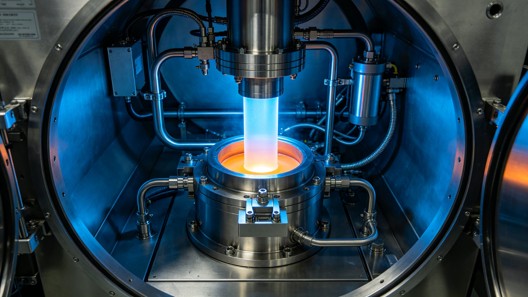 Fig 2: Vacuum evaporation chamber with electron beam source showing the deposition environment for oxide thin films.
Oxide thin films deposited from our evaporation materials serve critical functions across a diverse set of industries. The versatility of oxide compounds—from their optical transparency and dielectric strength to their chemical inertness—makes them indispensable in modern materials engineering.
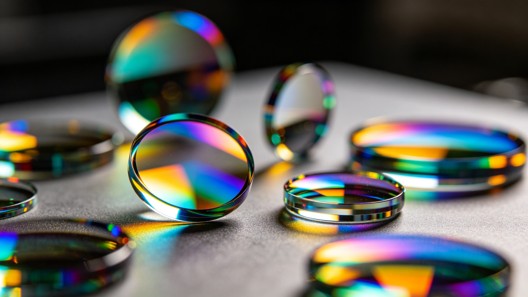 Fig 3: Precision optical lenses with multilayer dielectric coatings displaying characteristic iridescent interference patterns.
To help you quickly identify the right material for your coating design, we have organized our oxide evaporation portfolio by functional role. Each category encompasses multiple compositions with varying refractive indices, transparency ranges, and mechanical properties.
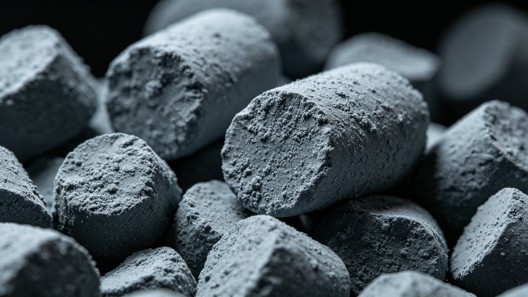 Fig 4: Magnified view of sintered oxide granule microstructure showing the porous ceramic morphology of evaporation material pellets.
Reliable thin-film performance begins with consistent source material quality. Our quality management system encompasses every stage of production, from raw material sourcing through final packaging, to ensure that every gram of oxide evaporation material you receive meets or exceeds your expectations.
Every coating process has unique requirements, and standard catalog products do not always fit the bill. That is why we offer fully customizable oxide evaporation materials tailored to your exact specifications. Whether you need a non-standard purity level, a specific particle size distribution, a custom tablet dimension, or an entirely new mixed-oxide composition, our engineering team can develop and produce the material you need.
Our custom synthesis capabilities include dopant incorporation for precisely controlled electrical or optical properties, co-sintered multi-component tablets for single-source co-deposition, and specialized preparations designed for particular deposition systems or process recipes. We support projects from gram-scale R&D quantities through kilogram-scale production runs, with the same rigorous quality control applied to every order size.
Reach out to our technical team with your material requirements, and we will work with you to develop a solution that matches your performance targets and budget parameters.
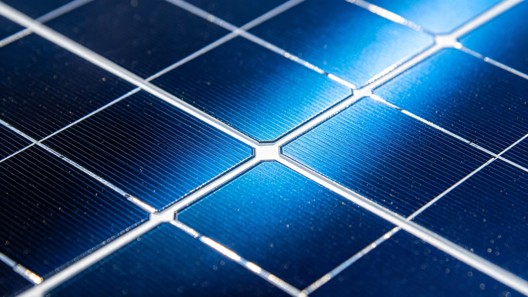 Fig 5: Solar photovoltaic cells with oxide-based anti-reflective and transparent conductive coatings for enhanced energy conversion.
Proper storage and handling of oxide evaporation materials help preserve their purity and ensure optimal deposition performance. We recommend the following best practices:
| Catalog Number | Product Name | Order | Quantity |
|---|---|---|---|
| SEMOEM-0001 | 99.9% Silicon Monoxide Infrared-Coating Granules (SiO) | Inquiry | |
| SEMOEM-0002 | 99.99% Scandium Oxide Evaporation Granules (Sc2O3) | Inquiry | |
| SEMOEM-0003 | 99.99% Yttrium Oxide High-Temperature Evaporation Granules (Y2O3) | Inquiry | |
| SEMOEM-0004 | 99.99% Lutetium Oxide Evaporation Granules (Lu2O3) | Inquiry | |
| SEMOEM-0005 | 99.9% Holmium Oxide 2 μm Laser-Material Granules (Ho2O3) | Inquiry | |
| SEMOEM-0006 | 99.99% Dysprosium Oxide Evaporation Granules (Dy2O3) | Inquiry | |
| SEMOEM-0007 | 99.99% Terbium Oxide Evaporation Granules (Tb4O7) | Inquiry | |
| SEMOEM-0008 | 99.99% Lanthanum Oxide Evaporation Granules (La2O3) | Inquiry | |
| SEMOEM-0009 | 99.99% Gadolinium Oxide Functional Granules, 0.1–100 μm (Gd2O3) | Inquiry | |
| SEMOEM-0010 | 99.99% Indium Tin Oxide Transparent Conductive Evaporation Granules (ITO) | Inquiry |
For Research or Industrial Raw Materials, Not For Personal Medical Use!
|
There is no product in your cart. |

Eata Energy is your trusted partner for high-performance energy materials, customized R&D support, and a stable global supply chain. We support you every step of the way in energy innovation.
Enter your E-mail and receive the latest news from us.
Copyright © Eata Energy. All rights reserved.
