
In a launch vehicle, every kilogram of structure is a kilogram of payload surrendered. That unforgiving arithmetic pushed metallurgists toward an unlikely ally — lithium, the lightest metal on the periodic table — and produced a family of aluminum alloys that flies lighter, stiffer and colder than anything that came before it.
Eata Energy supplies aluminum-lithium raw materials for aerospace research and advanced industrial programs: third-generation grades such as 2195, 2198, 2099, 2199, 2050 and 2060, available as sheet, plate, extrusion, forging stock and powder — the forms that turn low density into real hardware.
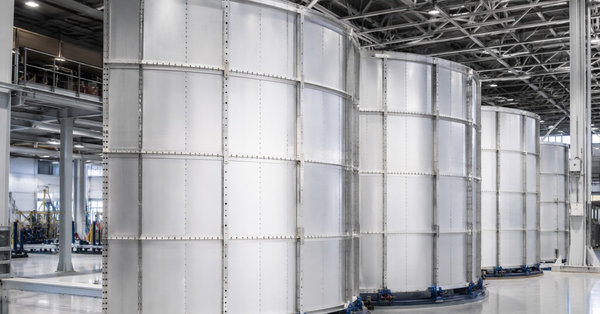 Curved fuselage and tank barrel panels — the signature product form of modern aluminum-lithium structures.
Lithium is a metallurgical bargain. At 0.534 g/cm³ it is the lightest metallic element, and dissolved into aluminum it does two jobs at once: each weight percent of lithium trims roughly 3% from the alloy's density while adding about 6% to its elastic modulus. Strength arrives through fine precipitates — Al₃Li (δ′) and the Al₂CuLi T₁ phase — formed during T8 aging cycles and supported by micro-additions of copper, magnesium, silver and zirconium.
The family took three generations to mature. The second generation (2090, 2091, 8090, carrying 2% lithium or more) chased density aggressively but paid for it with anisotropy and brittle short-transverse behavior. The third generation rebalanced lithium between about 0.75 and 1.8 wt%, exchanging a little density for far better toughness, corrosion performance and manufacturability — and it is this generation, from 2195 and 2198 to 2099, 2050 and 2060, that now builds airliners and rockets. One rule governs all of it: alkali impurities such as sodium and potassium must stay in the single-digit-ppm range, or toughness and ductility collapse. In this alloy family, composition control is not a formality.
| Grade | Generation / System | What Sets It Apart | Typical Uses |
| 2195 (UNS A92195) | 3rd gen, Al-Cu-Li-Ag | About 590 MPa UTS at 2.70 g/cm³; exceptional cryogenic strength; ~30% stronger and 5% lighter than 2219 | Cryogenic propellant tanks, launch vehicle barrels, spacecraft structure |
| 2198 | 3rd gen, Al-Cu-Li | High specific stiffness and compressive strength; outstanding friction-stir weldability — the Falcon 9 tank-wall alloy | Welded tank walls, fuselage skins, pressure cabins |
| 2099 | 3rd gen, Al-Cu-Li-Zn | High-strength extrusion grade with strong fatigue performance | Wing and fuselage structure, extruded stringers and frames |
| 2199 | 3rd gen, Al-Cu-Li | Balanced strength and toughness in sheet and plate forms | Wing skins, load-bearing panels |
| 2050 | 3rd gen, Al-Cu-Li-Ag | Thick-plate strength with good stress-corrosion resistance | Frames, ribs, thick machined sections |
| 2060 | 3rd gen, Al-Cu-Li | Damage-tolerant sheet grade (T8E30-type tempers) | Fuselage skins, damage-resistant panels |
| 2297 / 2397 | 3rd gen, Al-Cu-Li | Thick-section strength for pressure-boundary service | Tank domes, bulkheads |
| 8090 | 2nd gen, Al-Li-Cu-Mg | Historic low-density grade (2.54 g/cm³) | Legacy programs, reference and research stock |
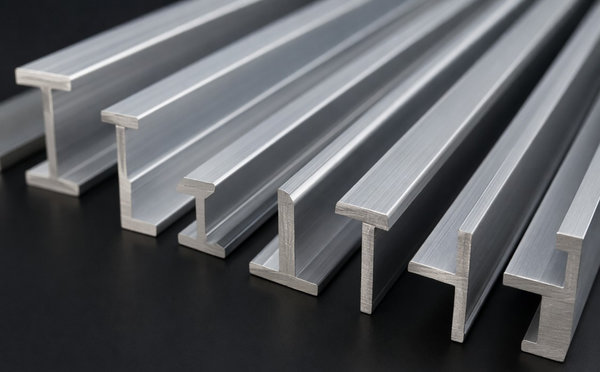 Extruded T, L and Z sections — stringers and stiffeners ready for airframe and tank structures.
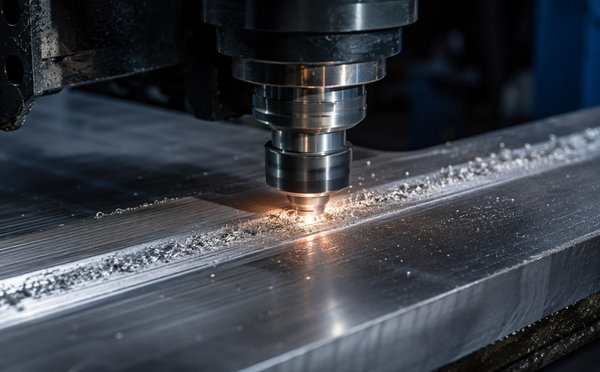 Friction stir welding — the joining process that unlocked welded aluminum-lithium tank structures.
Cryogenic propellant tanks are this alloy family's defining job. The Space Shuttle's Super Lightweight External Tank flew alloy 2195 from 1998 onward, more than 10% lighter than the tank it replaced; today, friction-stir-welded 2198 forms the 3.66 m diameter tank walls of the Falcon 9 and Falcon Heavy. Orion's crew module rides on 2195 spars with 2050 frames, ribs and window sections, and Centaur hardware on Atlas V carries the same pedigree.
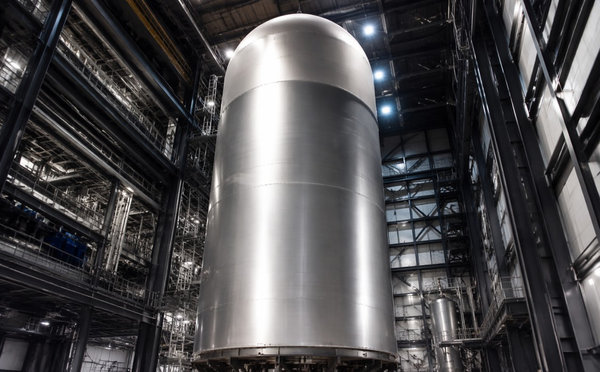 Cryogenic propellant tanks — the application that made aluminum-lithium alloys famous.
From the wings of the A-5 Vigilante — the first aerospace use of Al-Li — to the lower wing skins of the Airbus A380, the inner wing structure of the A350, the fuselage of the Bombardier CSeries (24% Al-Li by structure), the cargo floor of the Boeing 777X and the fan blades of Pratt & Whitney's PurePower geared turbofan, aluminum-lithium keeps proving that metallic airframes still have room to evolve.
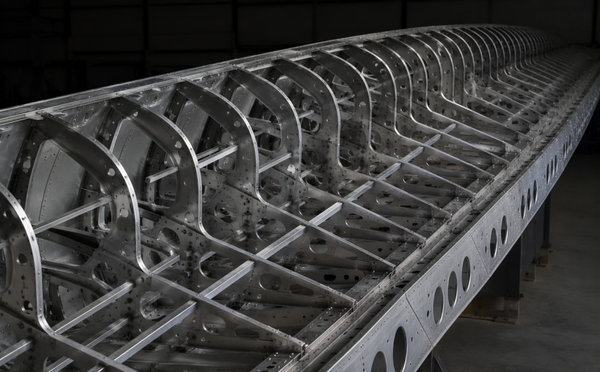 Wing ribs and spars are classic aluminum-lithium territory: stiffness-driven, weight-critical structure.
Formula One brake calipers and helicopter components — the EH101 among them — exploit the same stiffness-to-weight advantage in far smaller packages, proof that the family scales down as gracefully as it scales up.
Liquid-hydrogen aviation, reusable launch systems and next-generation cryogenic storage all need materials that grow stronger at 20 K instead of embrittling. Aluminum-lithium is one of the few metallic families that does exactly that.
Universities and R&D teams work with our sheet, plate and powder stock on friction stir welding development, next-generation compositions and additive manufacturing of Al-Li — programs we support with small-batch, well-characterized material.
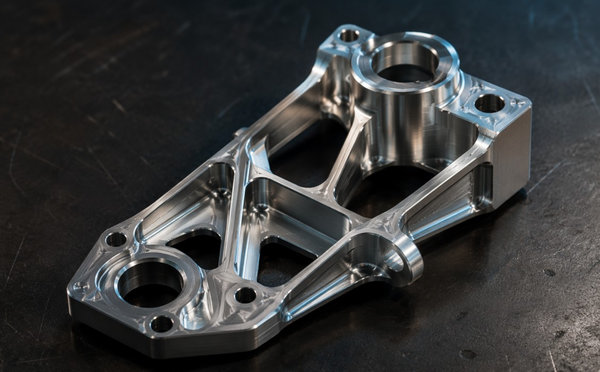 Machined fittings and brackets — where certified Al-Li billet turns into finished structure.
Non-standard gauges and widths, unusual tempers, custom extrusion dies, cut-to-size blanks, powders with specified size distributions, machined parts to drawing, even small development melts for experimental compositions — if it involves aluminum-lithium, it is worth a conversation. Send us your specification or your service conditions, and Eata Energy will respond with a material proposal and a quotation built around your program.
| Catalog Number | Product Name | Order | Quantity |
|---|---|---|---|
| HPAALA-0001 | Gallium-Indium Eutectic Alloy | Inquiry | |
| HPAALA-0002 | Gallium-Indium-Tin Alloy (Ga68.5In21.5Sn10) | Inquiry | |
| HPAALA-0003 | Aluminum Alloy 6082 Foil | Inquiry | |
| HPAALA-0004 | Aluminum-Scandium Master Alloy | Inquiry | |
| HPAALA-0005 | Aluminum-Magnesium Alloy Atomized Powder | Inquiry | |
| HPAALA-0006 | Aluminum Alloy 5083 Foil | Inquiry | |
| HPAALA-0007 | Aluminum Alloy 2024 Foil (300 × 300 mm, T3) | Inquiry | |
| HPAALA-0008 | Magnesium Alloy AZ31 Foil | Inquiry | |
| HPAALA-0009 | Aluminum Alloy 7075 Foil | Inquiry | |
| HPAALA-0010 | Gallium-Indium Eutectic Alloy Lumps | Inquiry |
For Research or Industrial Raw Materials, Not For Personal Medical Use!
|
There is no product in your cart. |

Eata Energy is your trusted partner for high-performance energy materials, customized R&D support, and a stable global supply chain. We support you every step of the way in energy innovation.
Enter your E-mail and receive the latest news from us.
Copyright © Eata Energy. All rights reserved.
