
Nickel stands as one of the most industrially significant transition metals, combining exceptional corrosion resistance with high ductility, ferromagnetism, and catalytic activity. Its silvery-white luster and ability to form alloys with remarkable mechanical and chemical stability have secured nickel's place across aerospace, energy storage, surface engineering, and chemical processing industries. With the accelerating shift toward electric vehicles and high-nickel cathode chemistries, demand for Class 1 high-purity nickel has surged to unprecedented levels — making material quality and traceability more critical than ever.
Eata Energy delivers high-purity nickel metal spanning grades from 99.9% to 99.99%+ (3N to 4N+), available in powder, pellets, granules, sputtering targets, foil, rod, and custom-engineered forms. Every batch ships with a detailed Certificate of Analysis generated through ICP-MS, XRF, and other advanced characterization techniques, giving researchers and process engineers the data confidence needed for reproducible results.
Nickel's position in Group 10 of the periodic table confers a distinctive blend of properties that few other metals can match. Its relatively slow oxidation rate provides natural passivation, while its mechanical strength and ductility remain excellent across a broad temperature window.
| Property | Value | Notes |
| Atomic Number | 28 | Group 10, Period 4 |
| Atomic Weight | 58.69 g/mol | |
| Density | 8.902 g/cm³ | Higher than Co, lower than Cu |
| Melting Point | 1455°C | Higher than Co, Fe |
| Boiling Point | 2732°C | |
| Curie Temperature | 354°C | Ferromagnetic |
| Young's Modulus | 200 GPa | Stiff and strong |
| Thermal Conductivity | 90.9 W/m·K | Good heat conductor |
| CAS Number | 7440-02-0 | EINECS: 231-111-4 |
| Electronegativity | 1.91 (Pauling) |
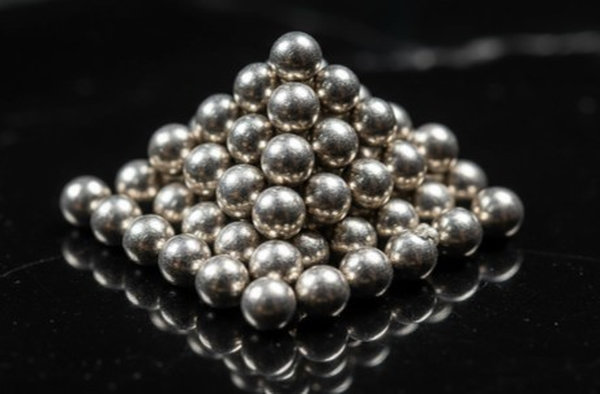 Figure 1: Bright silvery-white high-purity nickel pellets arranged on a reflective obsidian surface
Nickel is one of only four elements that are ferromagnetic at room temperature — alongside iron, cobalt, and gadolinium. Its Curie temperature of 354°C, while lower than cobalt's, is still well above most operating environments for magnetic devices. This magnetic behavior, combined with exceptional corrosion resistance in alkaline media and many neutral aqueous environments, positions nickel as a material of choice for magnetic sensors, actuators, and electrochemical devices.
Our nickel inventory covers the full spectrum of research and industrial requirements, from fine powders optimized for cathode precursor synthesis to fully dense sputtering targets for thin-film deposition systems.
Nickel powders serve as feedstock for NMC and NCA cathode precursor coprecipitation, powder metallurgy compaction, and catalyst preparation. Available in controlled particle size distributions and surface area specifications to match specific process chemistry requirements.
These formats provide convenient feedstock for vacuum melting, electroplating anode baskets, and thermal spray applications. Their larger size reduces oxide formation during handling and simplifies charging into furnace crucibles and plating baths.
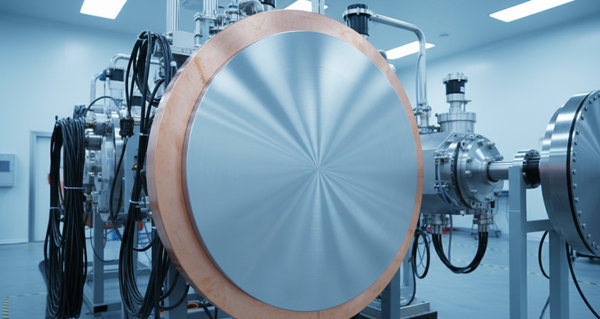 Figure 2: Large-format nickel sputtering target bonded to a copper backing plate in a coating facility
Hot-isostatically pressed (HIP) nickel targets achieve full theoretical density with uniform grain structure, ensuring stable sputter rates and minimal particle generation during PVD processes. Targets are available monoblock or indium-bonded to copper backing plates.
Wrought nickel products support electrochemical cell fabrication, corrosion testing, and mechanical property studies. Cold-rolled foil provides consistent thickness for battery current collectors and electrode substrates.
The drive toward higher energy density in lithium-ion batteries has pushed cathode chemistry toward nickel-rich formulations — NMC 811, NMC 955, and NCA compositions where nickel comprises 80% or more of the transition metal content. These cathodes deliver 200–250 mAh/g specific capacity, enabling longer range for electric vehicles and higher energy density for grid storage systems. Our high-purity nickel products, with tightly controlled iron, copper, and zinc impurity levels below 10 ppm, provide the feedstock consistency essential for reproducible coprecipitation and calcination processes in cathode precursor manufacturing.
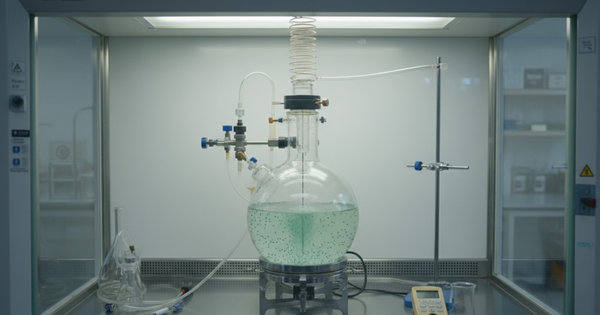 Figure 3: Glass reactor vessel containing green-tinted nickel sulfate solution during NMC precursor synthesis
Alloys such as Inconel 718, Inconel 625, Hastelloy X, and Nimonic 80A rely on nickel as the matrix element, strengthened by γ' precipitates (Ni₃Al,Ti) and solid-solution hardening from chromium, molybdenum, and tungsten. These materials maintain mechanical integrity above 700°C in oxidizing and corrosive environments, making them irreplaceable for turbine disks, combustion chambers, and nuclear reactor components. High-purity nickel starting stock ensures controlled trace element profiles that directly influence creep resistance and oxidation behavior.
Nickel electrodeposition produces decorative, corrosion-resistant, and engineering coatings across automotive, electronics, and consumer goods industries. Watts nickel, sulfamate nickel, and bright nickel plating baths each demand specific nickel anode purity to avoid contamination by iron, copper, or lead that would degrade deposit quality. In research contexts, nickel plating studies explore pulse plating parameters, composite coatings with embedded nanoparticles, and alloy electrodeposition (Ni-Co, Ni-Fe, Ni-P, Ni-W) for functional surface engineering.
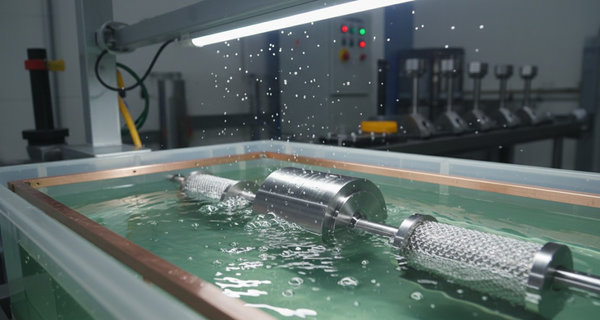 Figure 4: Metal workpiece undergoing nickel electroplating in a bright green-tinted plating bath
Nickel's combination of low vapor pressure, hydrogen permeability resistance, and bakeability to 500°C without oxidation makes it the standard material for ultra-high vacuum (UHV) components — flanges, gaskets, radiation shields, and mass spectrometer parts. Nickel-iron sealing alloys (Kovar, Invar) provide matched thermal expansion for glass-to-metal and ceramic-to-metal seals in hermetic electronic packages.
Raney nickel, prepared by alkaline leaching of Ni-Al alloy, remains one of the most widely deployed heterogeneous hydrogenation catalysts in industrial organic chemistry. Nickel nanoparticles and Ni-Mo sulfide catalysts are actively researched for dry reforming of methane, hydrodesulfurization, and electrocatalytic hydrogen evolution as lower-cost alternatives to platinum-group metals.
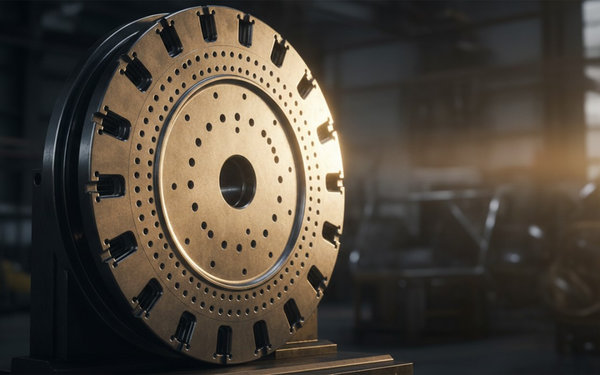 Figure 5: Precision-machined nickel-based superalloy turbine disk with intricate cooling hole pattern
Selecting the appropriate purity grade depends on the sensitivity of your application to specific trace elements. The following matrix provides practical guidance.
| Grade | Characteristics | Recommended For |
| Ni 99.9% | Standard battery-grade; Fe, Cu < 50 ppm | NMC/NCA precursor coprecipitation, electroplating anodes |
| Ni 99.95% | Enhanced purity; Fe, Cu < 20 ppm, low Co | High-nickel cathode research (NMC 811/955), alloy melting |
| Ni 99.99% | Analytical grade; full trace panel < 10 ppm | Superalloy research, sputtering targets, magnetic films |
| Ni 99.999% | Ultra-high purity; dedicated batch refining | Semiconductor barriers, UHV components, reference standards |
Eata Energy applies rigorous quality verification to every nickel batch before release. Our analytical protocol combines multiple complementary techniques to ensure comprehensive material characterization.
All shipments include a Certificate of Analysis, Safety Data Sheet (SDS), and appropriate transport documentation. Nickel metal is classified as NONH for shipping purposes, simplifying logistics compared with more reactive metals.
Research programs and process development initiatives frequently encounter requirements that standard catalog grades cannot satisfy. Eata Energy engages directly with your technical team to develop bespoke nickel products that address these specialized needs.
Contact our materials engineers early in your project to optimize nickel selection and specification for your specific cathode chemistry, alloy system, or surface engineering protocol.
| Catalog Number | Product Name | Order | Quantity |
|---|---|---|---|
| HPMHPN-0001 | High-Purity Nickel Powder, 99.5–99.7%, −325 Mesh | Inquiry | |
| HPM-HPN-0001 | Cut-Length High-Purity Nickel Wire | Inquiry | |
| HPM-HPN-0002 | Ultrafine High-Purity Nickel Wire, 9 µm | Inquiry | |
| HPM-HPN-0003 | Continuous-Spool High-Purity Nickel Wire | Inquiry | |
| HPM-HPN-0004 | Precision High-Purity Nickel Tube | Inquiry | |
| HPM-HPN-0005 | High-Purity Nickel Thin-Film Disc | Inquiry | |
| HPM-HPN-0006 | 4N High-Purity Nickel Sputtering Target | Inquiry | |
| HPM-HPN-0007 | Annealable High-Purity Nickel Rod | Inquiry | |
| HPM-HPN-0008 | 5N Top-Hat Nickel Single Crystal | Inquiry | |
| HPM-HPN-0009 | 5N Spherical Nickel Powder, 45 µm | Inquiry |
For Research or Industrial Raw Materials, Not For Personal Medical Use!
|
There is no product in your cart. |

Eata Energy is your trusted partner for high-performance energy materials, customized R&D support, and a stable global supply chain. We support you every step of the way in energy innovation.
Enter your E-mail and receive the latest news from us.
Copyright © Eata Energy. All rights reserved.
