
A human hair measures about 0.05 mm across. The thinnest stainless steel foils leave the rolling mill at one fifth of that — and still carry the corrosion resistance, strength and temperature tolerance of full-thickness plate. That combination of extreme thinness and full alloy performance is why foil keeps showing up wherever engineers run out of space but not out of demands.
Eata Energy supplies stainless steel foils across the industrial and research spectrum: austenitic 304/304L, 316/316L, 301 and 321, heat-resistant 310S, and ferritic 430 — in thicknesses from 0.01 mm to 0.2 mm, tempers from dead-soft annealed to super-elastic full hard, and finishes from matte 2D to bright-annealed mirror. Coils are slit to width, cut to length, or blanked to your drawing.
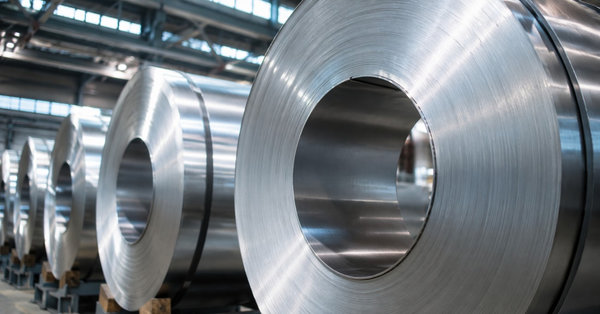 Master coils of cold-rolled stainless steel foil awaiting precision slitting.
The industry draws clean lines by thickness: below 0.2 mm you have foil, between 0.2 and 2 mm it is strip, and above 2 mm it becomes sheet. Within the foil range, the 0.01–0.1 mm band is classed as ultra-thin — territory that only repeated cold rolling on multi-roll precision mills (Sendzimir-type 20-high stands) can reach, with intermediate annealing at 950–1,100 °C between passes to restore ductility. Automated gauge control holds thickness within a tolerance band of just ±1–2 microns.
Chemically, nothing separates a foil from its parent plate — 304 foil still carries 18–20% chromium and 8–10% nickel and grows the same self-repairing passive film. What changes everything is temper. Cold work accumulates with every rolling pass, so the same grade can leave the mill dead soft and formable, or harder than many structural steels, depending on how the customer intends to use it.
| Grade | Family | Why Choose It | Typical Foil Uses |
| 304 / 304L | Austenitic | The all-rounder: 18–20% Cr, 8–10% Ni; annealed foil runs about 515 MPa with 40% elongation; L grade welds without sensitization | Shims, gaskets, formed parts, shielding, general fabrication |
| 316 / 316L | Austenitic + Mo | Molybdenum lifts resistance to chlorides and many process acids | Chemical plant components, marine fittings, corrosion-critical shims |
| 301 / 301B | Austenitic, high work-hardening | Springs back: up to 480–580+ HV in EH/SH tempers, tensile beyond 1,275 MPa at full hard | Springs, diaphragms, clips, flexible couplings |
| 321 | Ti-stabilized austenitic | Titanium stabilization resists sensitization during elevated-temperature service | Heat-treatment wrap, exhaust and furnace parts |
| 310S | Heat-resistant austenitic | Low-carbon grade serving up to about 1,050–1,100 °C in air | High-temperature seals, furnace fixtures |
| 430 | Ferritic | Magnetic, economical, with good oxidation resistance | Magnetic shielding, automotive trim, general fabrication |
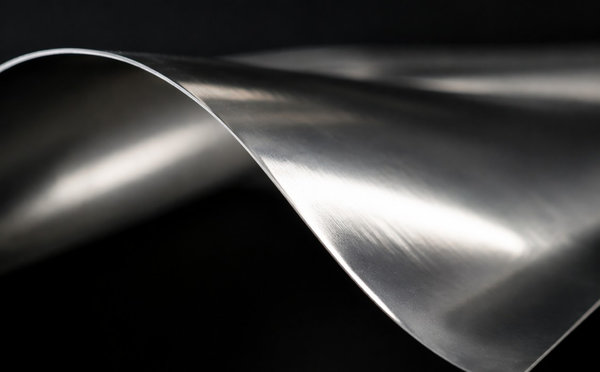 Ultra-thin stainless foil — flexible enough to curl, strong enough to hold a spring temper.
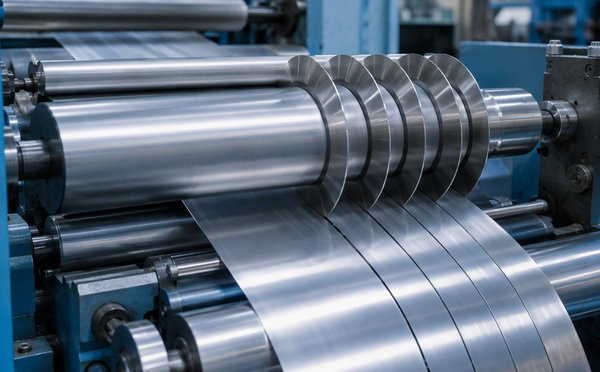 Precision slitting turns master coils into the narrow widths that stamping and winding lines need.
Alignment, spacing and sealing all depend on material that holds its dimension under bolt load and thermal cycling. Full-hard stainless foil stamps cleanly into shim washers, gasket rings and seal elements that stay put — and resist the media they seal against.
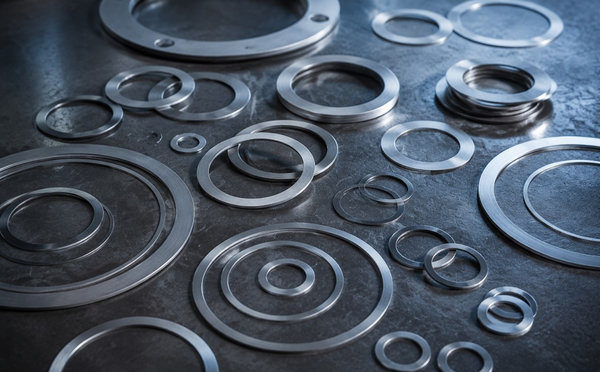 Shim washers and gasket rings stamped from full-hard stainless foil.
Pressure-sensing diaphragms, instrument springs, flexible couplings and disc springs live or die by elastic memory. Extra-hard 301-series foil delivers that memory in a corrosion-proof package, which is why it dominates this application space.
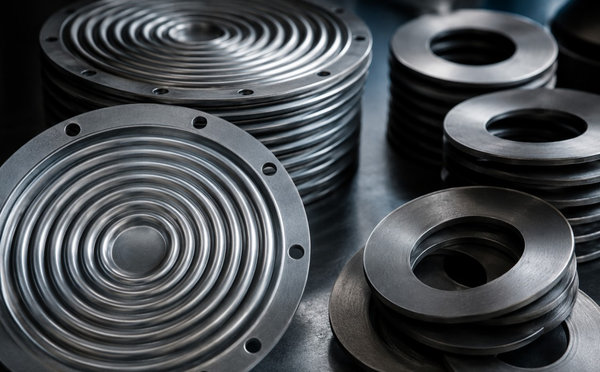 Corrugated diaphragms and disc springs rely on high-temper 301 foil for elastic memory.
Battery and fuel-cell laboratories reach for thin stainless foil constantly: as substrate and carrier material, as cell hardware and spacer stock, as blanks for bipolar-plate development, and as corrosion-stable partitions in electrolysis and flow-battery experiments. For energy research, foil gauge and edge quality often decide whether a prototype cell behaves or leaks.
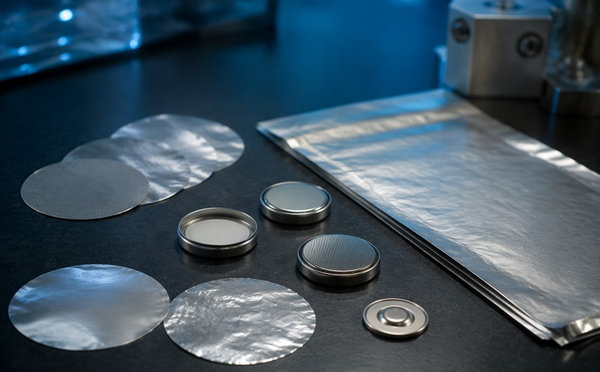 In battery and fuel-cell labs, stainless foil serves as substrate, spacer and cell hardware material.
Shielding cans, connector springs, cable wrap and enclosure gaskets exploit the same trio of properties: conductivity, formability and corrosion-proof surfaces that keep contact resistance low for years.
Toolmakers wrap parts in 321 or 310S foil packets before hardening to shield surfaces from oxidation and decarburization; furnace builders use the same grades for fixtures, liners and exhaust components that cycle past 1,000 °C.
Universities and corporate labs order mixed-grade, mixed-temper trial packs — a few meters each of 304, 316L and 301 in several gauges — to screen materials before committing a design. We treat these small, varied orders as first-class work, not as exceptions.
Non-standard thickness windows, coils slit to unusual widths, sheets cut to size, discs and blanks to drawing, special tempers between standard conventions, finishes beyond the standard menu, and mixed-grade trial packs for material screening — if your design needs it, ask. Send us the grade, gauge, temper and quantity you have in mind, and Eata Energy will reply with a technical proposal and a quotation.
| Catalog Number | Product Name | Order | Quantity |
|---|---|---|---|
| HPASSF-0001 | AISI 316 Stainless Steel Mesh | Inquiry | |
| HPASSF-0002 | AISI 316L Stainless Steel Atomized Powder | Inquiry | |
| HPASSF-0003 | AISI 316 Stainless Steel Plain Weave Mesh | Inquiry | |
| HPASSF-0004 | AISI 304 Stainless Steel Powder | Inquiry | |
| HPASSF-0005 | AISI 304 Stainless Steel Foil (Hard Temper) | Inquiry | |
| HPASSF-0006 | AISI 304 Stainless Steel Wire (Annealed) | Inquiry | |
| HPASSF-0007 | AISI 316 Stainless Steel Plain Weave Mesh (150x150 Wires/Inch) | Inquiry | |
| HPASSF-0008 | AISI 316L Stainless Steel Tube | Inquiry | |
| HPASSF-0009 | AISI 316 Stainless Steel Plain Weave Mesh (600x600mm) | Inquiry | |
| HPASSF-0010 | Iron-Chromium-Aluminum Alloy Powder | Inquiry |
For Research or Industrial Raw Materials, Not For Personal Medical Use!
|
There is no product in your cart. |

Eata Energy is your trusted partner for high-performance energy materials, customized R&D support, and a stable global supply chain. We support you every step of the way in energy innovation.
Enter your E-mail and receive the latest news from us.
Copyright © Eata Energy. All rights reserved.
