
Metallurgists have known since the 1950s that smaller grains mean stronger metal — the Hall–Petch relationship says so in one line of algebra. What the industry could not do for decades was push grain size below a micrometer in bulk material you could actually hold, machine and build with. Severe plastic deformation changed that, and ultrafine-grained alloys are the result.
Eata Energy supplies ultrafine-grained (UFG) materials for research programs and industrial applications alike: ECAE-conditioned sputtering targets, ECAP-processed bars and billets, HPT research discs, and roll-bonded or cryorolled UFG sheets — in aluminum, copper, titanium, magnesium and specialty alloy systems, with processing parameters documented batch by batch.
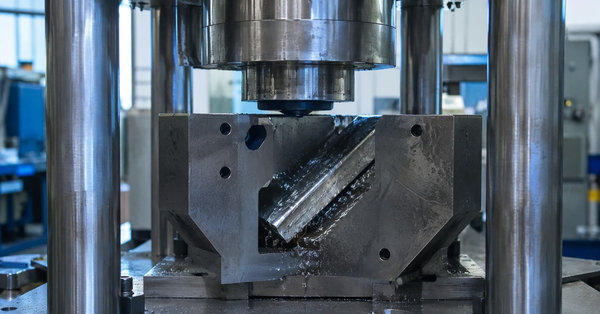 Equal-channel angular pressing — the workhorse process behind bulk ultrafine-grained stock.
Grain size sorts metallic materials into three regimes: conventional coarse-grained material sits above 1 μm, nanostructured material below 100 nm, and the ultrafine-grained band occupies the space between — roughly 100 nm to 1 μm. That band is where severe plastic deformation (SPD) lives. Techniques such as equal-channel angular pressing (ECAP, also called ECAE), high-pressure torsion (HPT), accumulative roll bonding (ARB), multi-directional forging and cryorolling pump enormous shear strain into a metal until its original grains fragment into a submicron mosaic — without changing the workpiece's external shape or adding anything to the chemistry.
This is the key point for buyers: a UFG alloy is not a new alloy. It is a familiar alloy — 1050 or 6061 aluminum, oxygen-free copper, commercially pure titanium, AZ-series magnesium — carrying a radically refined microstructure. The grade certificate looks the same; the performance does not.
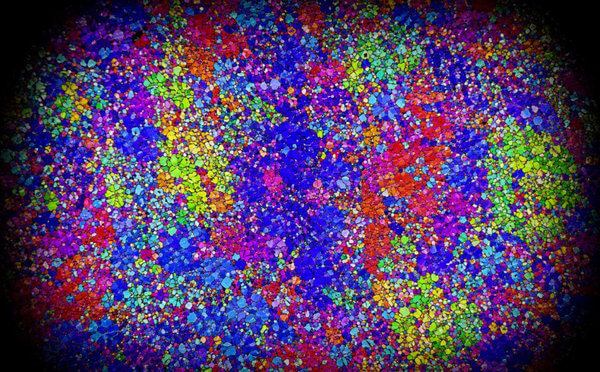 An orientation-map view of a refined microstructure: every color patch a crystal grain, each well under a micrometer across.
| Process | How It Works | Typical Output | Best For |
| ECAP / ECAE | Billet pressed repeatedly through intersecting equal-section channels; about 200% shear strain per pass at a 90° die, cross-section unchanged | Bars, billets, target blanks with submicron grains | Bulk stock, sputtering targets, forging preforms |
| HPT | Disc compressed under gigapascal pressure while one anvil rotates; extreme cumulative strain | Research discs refined to a few hundred nanometers | Laboratory studies, property screening |
| ARB | Sheets stacked and roll-bonded in repeated cycles | UFG sheet and strip | Sheet research, laminated structures |
| Cryorolling | Rolling at liquid-nitrogen temperature, adding deformation twins to the refinement mix | UFG sheet and foil | High-strength copper and titanium sheet |
| FSP / MDF | Friction-stir processing refines local zones; multi-directional forging refines bulk sections | Locally or bulk-refined sections | Functional surfaces, large preforms |
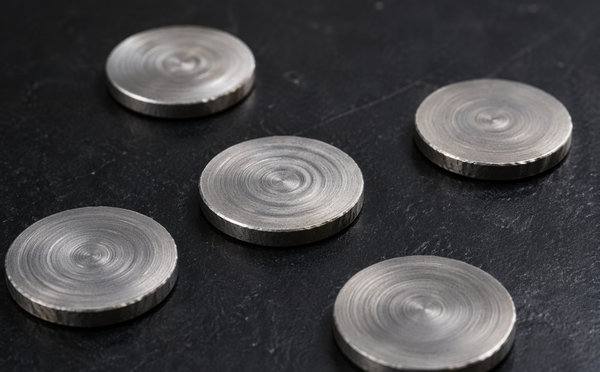 HPT-processed discs — small in size, enormous in accumulated strain.
This is the application where UFG metallurgy is already fully commercial. Conventional cast aluminum targets carry grains of 100 μm or more; ECAE-conditioned targets refine that to the submicron range, and the payoff is concrete: more uniform film thickness, measurably fewer wafer particles, band-free microstructure, and enough intrinsic strength for monolithic target designs that outlast bonded assemblies. Copper-alloy targets show the same pattern, with ECAE material in the low single-digit micron range outperforming incumbent targets on particle counts.
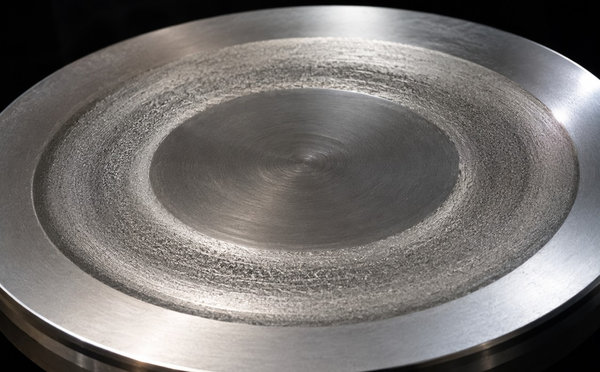 Fine, band-free microstructures translate directly into even erosion, film uniformity and target life.
ECAE has already produced forging stock at the hundred-millimeter-square scale, subsequently forged into flight hardware such as cargo door latches and landing-gear door brackets. The value proposition is straightforward: higher specific strength from a conventional, certifiable alloy chemistry — no new material qualification program required.
When a part shrinks to the scale of a few coarse grains, the microstructure stops being a background detail and becomes a design variable. UFG stock gives micro-formed gears, pins, springs and connector elements predictable, homogeneous behavior at millimeter and sub-millimeter dimensions.
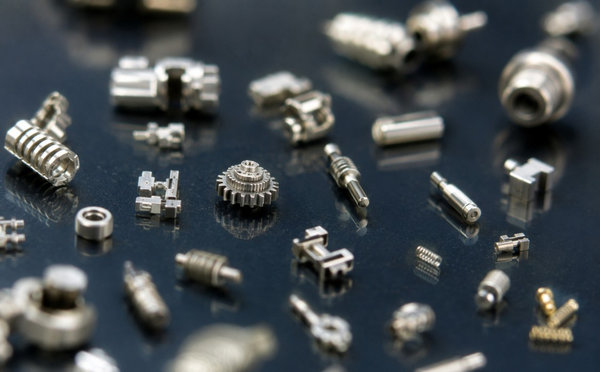 At millimeter and sub-millimeter part sizes, grain structure becomes a design parameter.
Deep, complex curvatures formed at moderate temperatures and practical strain rates — that is what UFG sheet brings to forming shops. Panels and shells that would tear or orange-peel in conventional tempers form smoothly when the grain field is submicron.
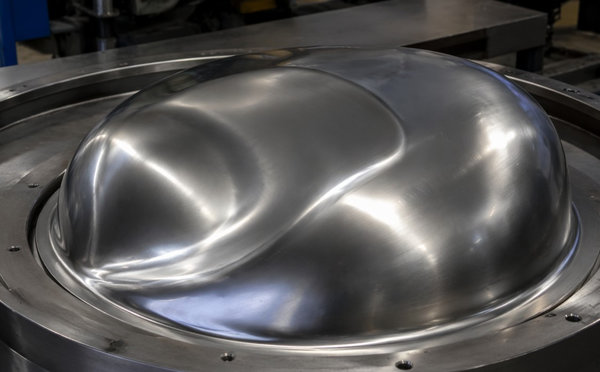 UFG sheet superplastically formed into deep, complex curvature.
ECAE-conditioned thermoelectric billets refine cast structures and lift conversion performance; UFG Al-Mg-Si conductors balance mechanical strength with electrical conductivity for demanding line work; high-strength UFG copper serves electrical contacts and connectors that must survive mechanical abuse. Functional materials benefit from grain refinement as much as structural ones — sometimes more.
Most UFG knowledge still lives in laboratories, and we supply them directly: HPT discs with documented pressure and rotation records, ECAP billets with route and pass logs, and small trial batches of experimental compositions for groups developing the next generation of nanostructured metals.
Your alloy, your target structure. Eata Energy arranges custom ECAP/ECAE pressing with specified routes and pass counts, HPT processing of customer-supplied alloys, ARB and cryorolling trials, ECAE-conditioned sputtering targets in custom geometries, and small development batches of experimental compositions. Send us the alloy system, the grain-size goal and the intended application — we will come back with a processing proposal and a quotation.
| Catalog Number | Product Name | Order | Quantity |
|---|---|---|---|
| HPAUGA-0001 | CuSn4 SG Ultra-Fine Grained Phosphor Bronze Strip | Inquiry | |
| HPAUGA-0002 | CuSn6 SG Ultra-Fine Grained Phosphor Bronze Strip | Inquiry | |
| HPAUGA-0003 | CuSn8 SG Ultra-Fine Grained Phosphor Bronze Strip | Inquiry | |
| HPAUGA-0004 | CuSn10 SG Ultra-Fine Grained Phosphor Bronze Strip | Inquiry |
For Research or Industrial Raw Materials, Not For Personal Medical Use!
|
There is no product in your cart. |

Eata Energy is your trusted partner for high-performance energy materials, customized R&D support, and a stable global supply chain. We support you every step of the way in energy innovation.
Enter your E-mail and receive the latest news from us.
Copyright © Eata Energy. All rights reserved.
