
Silicon oxide is one of the most abundant compounds on Earth, yet in its refined forms it quietly enables some of the most demanding technologies ever built. Every optical fiber that carries internet traffic, every silicon ingot pulled for a semiconductor wafer, and every quartz resonator that keeps a 5G base station on frequency depends on SiO₂ delivered at exceptional purity.
Because performance requirements differ enormously between a furnace tube, a UV lens and a CMP slurry, silicon oxide reaches the market as a family of distinct material forms — electrically fused quartz glass, synthetically produced fused silica, high-purity quartz (HPQ) sand, hydrothermally grown single crystals, and nano-scale fumed or colloidal powders. This page introduces the silicon oxide materials available from Eata Energy, their key properties, and the industries they serve.
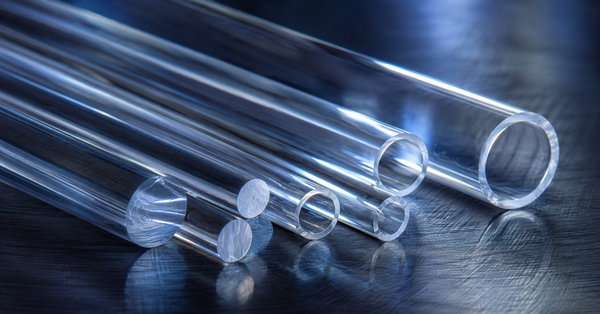 High-purity fused quartz tubes and rods — the starting glassware for semiconductor, optical and laboratory components.
Silicon oxide (SiO₂, also called silicon dioxide or simply silica) is built from silicon atoms covalently bonded to four oxygen neighbors in a continuous SiO₄ tetrahedral network. The way that network is arranged defines the material. In crystalline quartz the tetrahedra form an ordered lattice: α-quartz, stable at room temperature, transforms to β-quartz at 573 °C with a small but abrupt volume change. Melt quartz and cool it, and the same network freezes into a disordered glass — fused quartz, or fused silica when produced synthetically from SiCl₄.
This duality gives SiO₂ an unusual portfolio of behaviors. The amorphous glass combines near-zero thermal expansion, broadband optical transparency and excellent dielectric insulation. The crystal, lacking a center of symmetry, is piezoelectric — a property industry has exploited for frequency control since the 1920s without finding a superior substitute. Both forms share outstanding chemical inertness: significant attack comes only from hydrofluoric acid and hot concentrated phosphoric acid.
| Material Form | Typical Grade / Purity | Key Characteristics | Representative Applications |
| Fused quartz glass (electric-fused natural quartz) | 99.9–99.99% SiO₂ | Outstanding thermal-shock resistance; low metal content; softening point ≈1660–1700 °C | Furnace tubes, wafer boats, crucibles, process chambers |
| Synthetic fused silica (SiCl₄ flame hydrolysis) | ≥99.99% SiO₂; OH controlled from <1 ppm to ~1000 ppm | Deep-UV transmission to ~170 nm; ultra-low fluorescence; laser-grade homogeneity | Excimer optics, fiber preform tubes, UV lamp envelopes |
| High-purity quartz (HPQ) sand & powder | 3N to 4N8 (99.9–99.998% SiO₂); 15 trace elements <20 ppm in 4N8 | Low alkali and boron; consistent fusion behavior for crucible forming | Quartz crucibles for CZ silicon pulling, semiconductor quartzware |
| Synthetic quartz single crystal | Electronic / optical grade, hydrothermal Z-growth | Piezoelectric; Q factors up to ~10⁶; α–β transition at 573 °C | Resonators, oscillators, filters, SAW substrates |
| Fumed silica (pyrogenic) | ≥99.8% SiO₂; surface area 50–400 m²/g | Thixotropic thickening, reinforcement, anti-settling | Silicone rubber, coatings, adhesives, CMP abrasives |
| Colloidal silica | 5–100 nm particles; sols up to ~50 wt% SiO₂ | Stable dispersion; uniform spherical particles; adjustable surface charge | CMP slurries, investment-casting shells, catalyst supports |
Purity figures are typical values; every shipment is accompanied by a certificate of analysis with ICP-MS trace-element data.
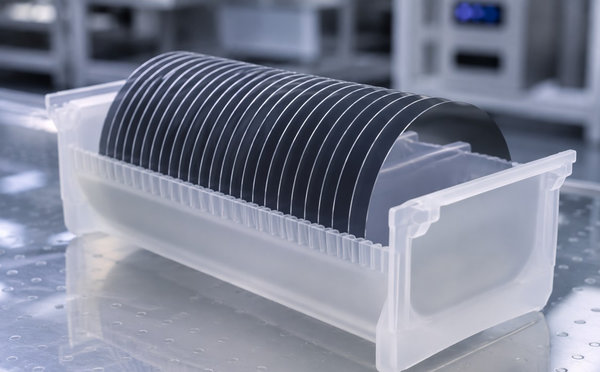 A translucent fused-quartz wafer boat carrying polished silicon wafers — a workhorse of diffusion and annealing furnaces.
No industry consumes high-purity quartz as intensely as semiconductors: roughly 96% of HPQ demand flows into chipmaking and silicon solar cells. Diffusion, oxidation and LPCVD furnaces run on fused-quartz process tubes, wafer boats and liners whose low metal content protects the wafer surface, since even ppb-level impurities migrating at 1000 °C can destroy device yield.
The same purity story drives the Czochralski crystal-pulling step. Quartz crucibles fused from 4N8-grade sand — SiO₂ above 99.998% with fifteen trace elements held below 20 ppm — contain molten silicon at around 1450 °C. A well-engineered crucible pairs a bubble-bearing outer layer with a 3–5 mm bubble-free transparent inner layer and supports roughly 400 hours of pulling, enough for about eight ingots. With single ingots now reaching 500 kg and 4.3 m in length, and a 300 mm ingot yielding on the order of two million chips, the market for these consumables is projected to grow from about US$390 million in 2025 to roughly US$807 million by 2032, a CAGR of 11.2%.
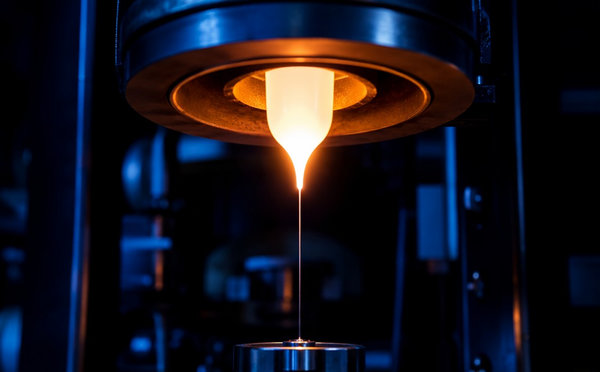 A white-hot silica preform feeding a hair-thin strand during optical fiber drawing.
Telecom-grade fiber begins as synthetic silica of sub-ppb purity, deposited by reacting SiCl₄ with oxygen. In outside vapor deposition (OVD) and vapor-phase axial deposition (VAD), flame hydrolysis builds up silica soot that is later chlorine-dried and consolidated. In modified chemical vapor deposition (MCVD), the reaction takes place inside a rotating high-purity substrate tube, giving superb control of the refractive-index profile — which is why MCVD remains the standard for specialty, rare-earth-doped and polarization-maintaining fibers. Germania raises the index, fluorine lowers it, and hydroxyl must be held near or below 1 ppm to keep attenuation down at telecom wavelengths.
That substrate tube is itself a silicon oxide product. Low-OH fused silica tubes — the established industry standard specifies OH below 1 ppm, and OH-free grades exist — serve as deposition substrates and as cladding jackets in rod-in-tube and rod-in-cylinder processes, where a single preform batch can be drawn into as much as 10,000 km of single-mode fiber.
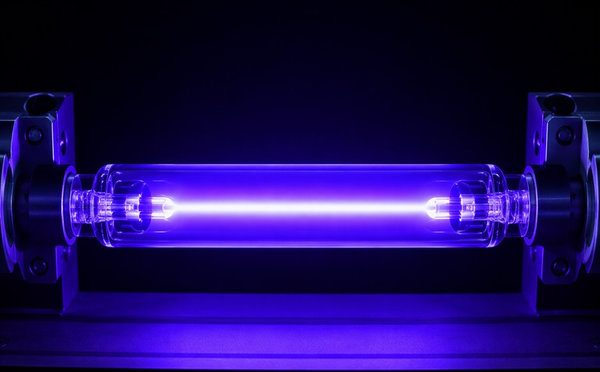 A quartz-envelope ultraviolet lamp in operation — fused silica passes deep-UV output that ordinary glass would absorb.
With a transmission window from about 200 nm to 3.5 μm — extendable to 170 nm in UV grades — fused silica is the default substrate for ultraviolet optics. ArF excimer-laser lithography at 193 nm, UV curing systems, spectrophotometers and medical excimer devices all rely on lenses, windows and prisms finished from synthetic fused silica with certified homogeneity and low fluorescence.
The lamp industry exploits the same property from the other side. Mercury-vapor germicidal and curing lamps need envelopes that pass 254 nm output, which ordinary soda-lime glass absorbs completely, and the envelope must run hot for years without devitrifying. Quartz meets both requirements at once.
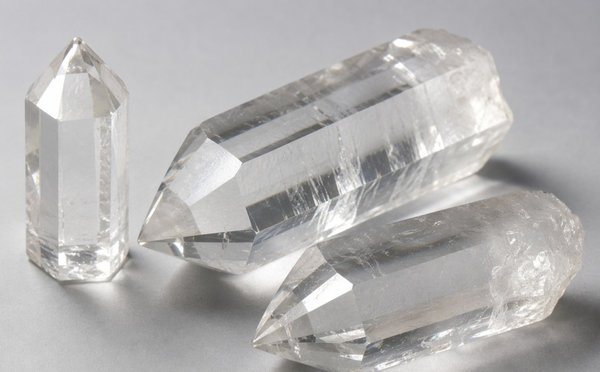 Hydrothermally grown synthetic quartz crystals — the raw material for precision resonator and oscillator blanks.
Crystalline quartz is piezoelectric: stress it and charge appears; apply a field and it flexes. Cut a blank at 35°15′ to the optical axis — the celebrated AT cut — and its resonant frequency becomes nearly temperature-independent around room temperature. AT-cut resonators cover roughly 800 kHz to 300 MHz; stress-compensated SC cuts, valued for low aging and low phase noise, anchor precision OCXOs; BT and FC cuts fill specialized niches.
Hydrothermally grown synthetic quartz supplies the defect-free raw material for these blanks, with mechanical quality factors running from tens of thousands to over a million. A century after quartz oscillators first stabilized radio transmitters, no alternative material has displaced them — every smartphone, base station, satellite and vehicle still keeps time with SiO₂.
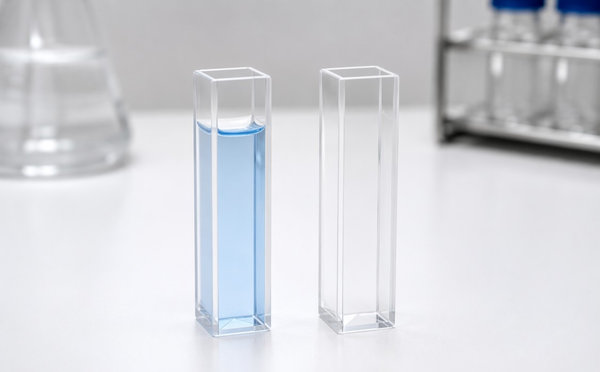 Fused-quartz cuvettes for UV-Vis spectroscopy, transparent well below the cutoff of optical glass.
In the analytical laboratory, fused-quartz cuvettes extend UV-Vis measurements below the ~320 nm cutoff of optical glass, while quartz beakers, crucibles and ICP torch bodies shrug off the thermal shock and acid exposure that would ruin borosilicate ware. Research furnaces, thermocouple sheaths and semiconductor test fixtures round out steady demand.
Beyond bulk glass and crystal, Eata Energy supplies silicon oxide in its nano-scale forms. Fumed silica — a pyrogenic powder with surface areas of 50–400 m²/g — is the reference reinforcing filler for silicone rubber, capable of raising tensile strength by a factor of fifty, and the standard thixotrope in coatings, adhesives and sealants. Colloidal silica sols of 5–100 nm particles anchor CMP polishing slurries for ILD, STI and metal planarization, bind investment-casting shells, and support catalyst beds.
Need a non-standard tube diameter, an unusual crucible profile, a specific crystal cut or a custom surface treatment? Eata Energy routinely produces made-to-order silicon oxide components: tell us the dimensions, purity grade, OH specification, optical finish or coating you require, and we will quote a tailored solution. Contact our sales team with your drawings or application brief to start the discussion — samples and small pilot batches are welcome.
| Catalog Number | Product Name | Order | Quantity |
|---|---|---|---|
| OCSO-0011 | SLC Core-Shell Silica Magnetic Microspheres Epoxy 1-2um | Inquiry | |
| OCSO-0012 | SLC Core-Shell Silica Magnetic Microspheres Epoxy 3-4um | Inquiry | |
| OCSO-0013 | SLC Core-Shell Magnetic Silica Microspheres Amino 3-4um | Inquiry | |
| OCSO-0014 | SLC Core-Shell Magnetic Silica Microspheres Amino 4-5um | Inquiry | |
| OCSO-0015 | SLC Core-Shell Magnetic Silica Microspheres Carboxyl 0.1-1um | Inquiry | |
| OCSO-0016 | SLC Core-Shell Magnetic Silica Microspheres Carboxyl 4-5um | Inquiry | |
| OCSO-0017 | SLC Core-Shell Magnetic Silica Microspheres Epoxy 0.1-1um | Inquiry | |
| OCSO-0018 | SLC Core-Shell Magnetic Silica Microspheres Epoxy 1-2um | Inquiry | |
| OCSO-0019 | SLC Core-Shell Magnetic Silica Microspheres Epoxy 2-3um | Inquiry | |
| OCSO-0020 | SLC Core-Shell Magnetic Silica Microspheres Epoxy 3-4um | Inquiry |
For Research or Industrial Raw Materials, Not For Personal Medical Use!
|
There is no product in your cart. |

Eata Energy is your trusted partner for high-performance energy materials, customized R&D support, and a stable global supply chain. We support you every step of the way in energy innovation.
Enter your E-mail and receive the latest news from us.
Copyright © Eata Energy. All rights reserved.
